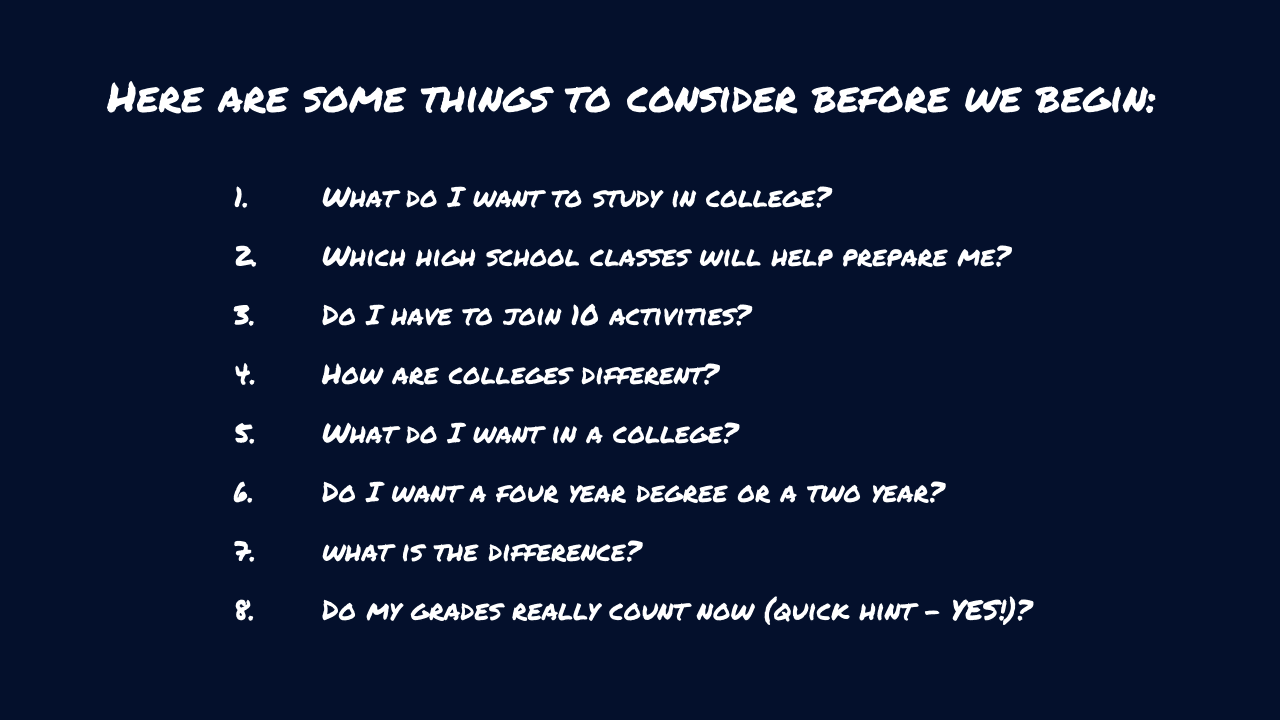
Since you're here, you're considering applying to college.
We will cover all of these topics and more throughout the next few modules and over the course of the next two years.
Colleges typically look for the following:
- What types of courses you take and if you are challenging yourself appropriately.
- How well you do in your core (Math, Science, English, Social Sciences, World Languages) classes. Grades matter - even freshman year, but junior year is a big part of an application review.
- How you spend your time when you are not in school or doing homework.
- What kind of person you are (through your essay, maybe an interview, letters of rec, extracurricular involvement).
- If you are involved. Have you been with a group/organization/job for multiple years or have you ever held a leadership position? You don't need to be involved in 10 different things!
- Your standardized test scores...sometimes
That is a lot...What are the most important things?
Grades/Courses
- Try to take one of each of your academic core each year - Math, Science, English, Social Sciences, and World Languages
- Did you take appropriately challenging courses? Consider Honors or AP/IB, etc.
- Weighted grades help with your GPA
- Some colleges will look at all grades and some will just look at core classes
- Review your transcript every semester/year - make sure everything is accurate, but also to get an understanding of what colleges will see
Freshman year counts, maybe even more than some others! Most high schools use a weighted 4.0 scale.
Your cumulative GPA is an average of all 8 semesters. Maybe the most important factor. However, you will be applying after 6 semesters (senior year counts as well).
It is more difficult to increase your GPA than decrease it.
One way to boost your GPA is by taking weighted courses. These often come with taking Honors or AP courses.
Advanced Placement (AP) Courses:
- After taking these classes, you can sit for the exam and if you get a high enough score, a college may give you credit.
- Scores range from 1-5 (credit sometimes for a 3 on the test)
- If you can handle the work and you like the subject, go for it! Don’t take it because you think you have to!
- Adds rigor to transcript which is good
Dual Credit / Dual Enrollment:
- Honors-Level GPA and rigor
- College credit from the partner school (typically a community college or 2-year school, but not always)
- Many colleges will give credit for most classes, but not all colleges accept dual credit
Extracurricular Activities:
- How do you spend your free time?
- More is not always better. Quality counts. Leadership is a good thing.
- Jobs count!
- Family situations count as well (care for a sibling or grandparent).
Summer Experiences:
- Job
- Vacations
- Pre-college programs - Enrichment Programs
- Sports camps
- Leadership programs- May not be used for admission considerations due to cost
- Volunteer
- Internships
- Do something!
Other Sections of the Application:
- Essays (lots more on that in the junior-year module!)
- Letters of Recommendation
- Interviews (sometimes, but not very common)
What does the admission review consist of?
2-year Options:
- Test scores or placement tests used for class placement
- Great money saving option
- Work with an advisor to choose classes to be sure they transfer: www.itransfer.org
- There are junior colleges with dorms that feed into 4-year colleges/universities
- Some have guaranteed transfer programs with a partner 4-year college/university
- Some very good jobs only need a 2- year degree or less
4-year Options:
Public University Admission:
- Did you take the required subjects (language, fine arts- U of California)
- What is the strength (CP, Honors, AP) of those courses?
- Test scores (ACT, SAT) maybe
- Despite their profiles, not all public universities are the same!
Private Colleges:
- More of a holistic process - meaning they will look at your entire profile as opposed to just grades/test scores
- Transcript - recommended courses; usually more flexible
- Achievement - type of class and GPA – strength of schedule and school
- Extra-curriculars - Smaller privates need involved students - it is what helps make their campus go
- Essay or personal statement - quite important
- Test scores - or not - www.fairtest.org
- If you can- Interview!
It's a lot...BUT...you are doing the work now, so you will be prepared!